
Our values
Our organisational values give our work meaning and purpose. These values underpin the way we interact with each other and drives our overall mission. Our six values are:
Solidarity
Kindness
Courage
Integrity
Inclusion
Relational
Hear from some of our colleagues on how they live out these values in their work.
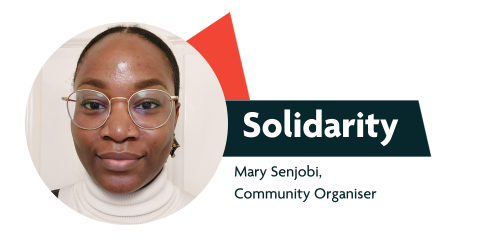
Solidarity
"It's important that the leaders I organise with are aware that I stand with them and work within our means to ensure they win justice on issues that they care about.
I work with a few schools in Redbridge, and I am continually amazed and energised by the young people’s passion to win change. Despite being in a different life stage to the young people of both primary and secondary age – it is important for me to stand in solidarity with them by taking their work seriously and listening to them to ensure they can act on what they're passionate about changing. I stand in solidarity with them by ensuring the campaigns we develop reflect their experience and stories instead of being a ‘good justice issue’ that will not impact their everyday reality."
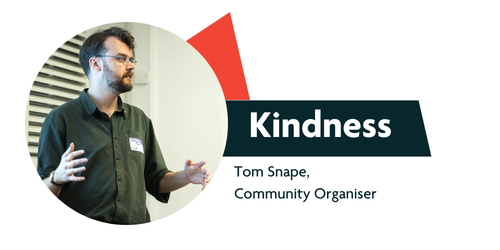
Kindness
"This work can be tough. During busy periods we can easily feel like we should be working all hours, putting every ounce of energy into the fight for justice – and demand the same of those around us. Our kindness value is a reminder that this way lies madness. If we are going to win, we need to first and foremost be kind to ourselves and those around us.
Is the person I am fighting alongside doing okay? How are their family? Do they need a break? Creating space to ask these questions, and for people to answer honestly, is the only way we can do the slow and respectful work of organising for the long term.
But to care deeply about the person I am organising with also requires a kind of courage and candour. We must avoid the ruinous empathy that causes us to shy away from difficult conversations or challenging feedback. Our relationships must be strong and trusting enough – and we must be kind enough – to tell someone when and how we think they could be doing better. Rooted in a vision of their greatness, and always with kindness."
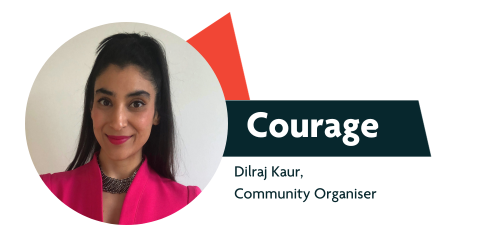
Courage
"Organising is not for the faint-hearted. This work takes courage. I've noticed organisers are drawn to the work of organising due to their own anger. It is not until we realise that we need to fuel this anger into action that we become courageous organisers.
We listen deeply, looking out for leaders with courage. The courage to firstly, voice their anger. Secondly, the courage to stand up for the issue they believe in. And thirdly, the courage to act on it despite it not being the norm. As an organiser, to have the profound courage to hold all this and bring it together to make change.
As a brown woman organiser, I've had to have the courage to be louder, stronger and believe that my voice is as important as a white man. Valerie Kaur says; "Go Gently. This is courageous work, and even if you don't see the fruits of your labour anytime soon, simply engaging your opponents with the ethic of love is revolutionary." For me, the slow and steady work of Organising takes courage. And finding ways to fuel anger into action whilst still feeling love takes courage."
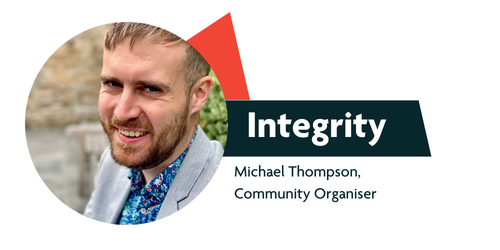
Integrity
"Community Organising helps me to see the value in the experiences that have shaped me, particularly my challenging times and defining moments. I want to always be confident that my inward beliefs match up with my outward actions, and an organisation like Citizens UK helps me to consistently check in with myself that the two are aligned. The organisation has encouraged me to integrate the struggles I had with identity, faith and self growing up and use them in the actions I take now as an Organiser.
A hero of mine is Bayard Rustin who organised the March on Washington during the civil rights movement in 1960s America. He made no secret of who he was, integrating his full identity and his life experiences into his work and public leadership. He always brought his whole self into the room and showed a huge amount of integrity and courage when meeting community leaders, power-holders and decision makers.
Our relationships are strengthened when we understand each other deeply, and in my time as an Organiser, I have learned to let go of the fear of confronting difference across civil society. I try to bring my whole self to my work, like Rustin did, to our communities and public spaces, with the hope that others are encouraged to do the same, as people who own their stories and use them as fuel for action."
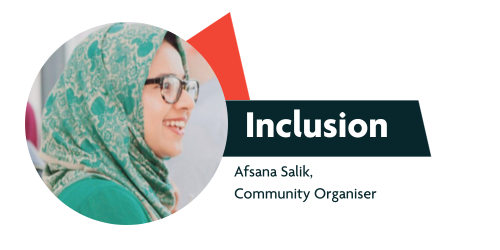
Inclusion
"Citizens UK allows me to be a true version of myself, where my faith and culture are well respected. Inclusion is at the core of our work, and there’s not only an understanding of differences, but a celebration of them. As well as receiving work benefits such as flexible working hours and a good annual leave allowance, there are smaller day to day things that reflect our inclusive culture: for example, having the option to change my working hours during Ramadan, or being given breaks to perform prayers and during staff meetings. With my faith being extremely important to me, being given space to be myself is what makes working here so fulfilling.
Inclusivity is also integral to community organising, and I embed this value throughout my work. For example, by making sure our community leaders are from diverse communities and that they’re not only included but feel heard. There’s also been work around our training sessions and how we can make them as inclusive as possible, through offering childcare facilities and bringing in learnings from different faiths and cultures."
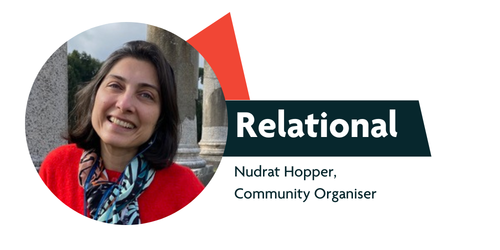
Relational
"The question I’m asked most often at the start of a relational meeting is what makes it different from a networking meeting or indeed any other work meeting. And the answer surprises most: a purposeful conversation built on curiosity, to discover each other’s motivations. The surprise is not that the answer is earth-shattering or new but that there are people still willing to put the other person first.
When there is a willingness to ‘not sell something’ but rather make space for others to be heard, allows our fellow citizens to become aware of themselves in relation to you. These powerful conversations suspend judgement, connect to people and go beyond chit-chat. I, inhabiting (and treasuring) a number of different identities, have found that this community organising practise not only honours but fulfils my deepest convictions: acknowledging the other person, who-so-ever that might be, hearing the unique and distinct voice of others which enables me to recognise them fully. And most importantly, recognising that they have the power to change things through collaboration with others."
Find out what it's like to work at Citizens UK and see our current vacancies.